Sugarmint

In this exclusive interview, Navkaran Singh Bagga, Founder & CEO of AKVO, shares how Atmospheric Water Generation (AWG) is redefining access to clean drinking water through sustainable, decentralized infrastructure built for a changing climate.

From Weather to Water Infrastructure
The idea behind AKVO wasn’t a single breakthrough moment—it came from repeatedly seeing communities depend on depleting groundwater and unreliable supply systems while overlooking the vast, renewable water source already present in the atmosphere.

By treating humidity as infrastructure rather than weather, AWG creates drinking water directly at the point of consumption, reducing dependence on pipelines, tankers, and stressed aquifers.

Making AWG More Energy Efficient
Energy use has long been one of the biggest criticisms of atmospheric water generation. At AKVO, improving the energy-to-water ratio became a core engineering focus.

Through optimized condensation cycles, heat recovery systems, intelligent controls, and renewable energy integration, AKVO continuously improves performance while adapting output to real-world climate conditions.

Beyond Collection: Delivering Safe Drinking Water
Generating water from air is only the beginning. The collected water undergoes a multi-stage treatment process including:

  • Filtration and purification
  • Controlled remineralization
  • Continuous quality monitoring

This ensures the water consistently meets recognized drinking water quality standards and remains suitable for institutional and industrial use.

Making Adoption Easier with Water-as-a-Service
For many organizations, the challenge isn’t confidence in the technology—it’s the upfront investment.

AKVO’s pay-per-liter model lowers adoption barriers by allowing businesses and institutions to consume water as an operating expense instead of committing to large capital purchases from day one.

Building in India, for Indian Conditions
Localization remains a key focus for AKVO. Manufacturing and assembly continue to move deeper into India’s supply chain ecosystem while maintaining access to specialized global components where needed.

Building closer to deployment conditions also enables faster learning, better optimization, and stronger supply resilience.

The Future Is Decentralized Water
As cities face increasing water stress, Navkaran believes future water systems will not rely on one centralized source alone.

Instead, resilient cities will combine conventional supply with distributed water generation—deploying solutions across campuses, commercial spaces, public infrastructure, and industrial sites.

Advice for Climate-Tech Founders
Climate technology moves at the pace of physics, not software.

Navkaran’s advice to founders is simple: stay obsessed with the problem, expect long development cycles, and remain close to real-world deployment—because lasting innovation is built in the field.

You can read the full interview here

Tech Stories

India is facing a critical paradox: we are one of the world’s fastest-growing economies, yet nearly 600 million of our people live under severe water stress. With roughly 70% of our surface water contaminated and groundwater tables rapidly declining, the drinking water gap has evolved from a local hurdle into a major national infrastructure challenge.

As a founder building Atmospheric Water Generation (AWG) technology at Akvo, I am frequently asked if pulling drinking water from the air can truly scale.

The honest answer? AWG will not replace rivers, rainwater harvesting, or municipal supply. However, it is fast becoming the most credible decentralized option to bridge the last-mile drinking water gap. It steps in precisely where the ground has failed us, the pipes haven’t reached, or the existing source is unsafe.

The atmosphere above India holds an estimated 13,000 cubic kilometers of water vapor at any given time—far more than all of our rivers combined. AWG simply taps a tiny sliver of this endless, renewable reservoir.

Moving the Needle Where It Matters Most

The goal of AWG isn’t to flood cities with air-to-water units. Instead, it is meant to target acute pain points where conventional infrastructure naturally struggles:

  • Schools & Healthcare Centers: Providing pure water in districts heavily affected by fluoride or arsenic.

  • Remote & Border Posts: Eliminating the punishing logistics of trucking water to distant terrains.

  • Campuses & Industrial Sites: Replacing the massive financial and plastic waste of packaged bottled water.

  • Disaster Relief: Deploying mobile AWG units that can be airlifted and producing clean water within hours.

This targeted approach offers a powerful opportunity for Corporate Social Responsibility (CSR) and ESG capital. Rather than funding temporary fixes, partners can invest in decentralized infrastructure that delivers verifiable impact data daily through IoT dashboards—measuring success in clean liters generated, not just photographs.

Turning the Economic Tide

What was once an expensive novelty is now a commercially viable reality. Thanks to advancements in compressor efficiency, heat exchanger design, and predictive maintenance, the cost per liter has dropped significantly. In warm, humid climatic zones, AWG is now highly competitive with—and often cheaper than—packaged or tankered water once you factor in logistics and plastic disposal.

Furthermore, the rise of the Water-as-a-Service (WaaS) model allows schools, hospitals, and municipalities to pay only for the liters they consume, removing the upfront capital barrier entirely.

Knowing the Limits

True credibility in climate technology relies on what we refuse to overpromise. AWG is a specialized drinking water solution designed to deliver the vital 20 to 30 liters a person needs each day. It is environment-dependent, meaning output naturally drops in cold, dry regions like high-altitude Ladakh or during peak North Indian winters. To manage energy consumption sustainably, pairing AWG with rooftop solar is rapidly becoming our default design.

The Mesh Architecture of Water

India’s water future won’t rely on a single, grand pipeline. It will look like a collaborative mesh: surface water where abundant, groundwater where sustainable, rainwater harvesting where possible, recycled water for utilities, and atmospheric water precisely where the other options fail.

At Akvo, we are building for that future—one decentralized unit at a time.

This article was originally published on Financial Express. You can read the full, unabridged piece here: Air to Water: Can Atmospheric Technologies Solve India’s Drinking Water Gap?

TechGraph

India’s growing water crisis is forcing cities to rethink where water comes from. From declining groundwater levels in Bengaluru to recurring shortages in Chennai and increasing pressure on urban infrastructure, conventional water sources are under strain.

Yet one abundant resource often goes unnoticed: the moisture present in the air around us.

Atmospheric Water Generation (AWG) technology captures humidity from ambient air and converts it into safe drinking water. Unlike traditional water systems, AWGs do not rely on groundwater, municipal pipelines, or tanker deliveries. Water is produced directly at the point of use through a process of condensation, purification, and mineralisation.

For commercial buildings, hospitals, educational institutions, industries, and residential developments, AWG offers a decentralised and sustainable water solution. It reduces dependence on external water sources while supporting water security and sustainability goals.

The technology is particularly effective across much of India, where humidity levels remain favourable for a significant part of the year. Advances in energy efficiency, IoT-based monitoring, and system performance have also made AWG increasingly viable from both operational and economic perspectives.

As urban populations grow and climate pressures intensify, water resilience will require more than traditional infrastructure alone. Distributed solutions like atmospheric water generation can play an important role in strengthening future water security.

The question is no longer whether air can become a water source. Across India and beyond, it already is.

Read the full article by Navkaran Singh Bagga here

CSR BOX

Water scarcity is no longer only about the availability of resources — it is increasingly about equitable access to safe drinking water.

Globally, nearly 2.2 billion people lack safely managed drinking water services, while millions spend hours each day collecting water. In India, where almost 18% of the world’s population depends on just 4% of global freshwater resources, water stress continues to affect millions.

Yet, in many communities, the issue is not the absence of water. Water sources may exist, but contamination, high TDS levels, fluoride, iron content, and inadequate treatment systems often make safe drinking water inaccessible.

This shifts the focus from water availability to water quality, accessibility, and reliability.

Traditionally, water interventions have prioritised infrastructure such as borewells, pipelines, and storage systems. While important, infrastructure alone does not guarantee sustainable impact. Long-term water security requires solutions supported by monitoring, technology, and community participation.

Key questions must guide future interventions:

  • Is safe water being delivered consistently?
  • Are systems sustainable over time?
  • How is water quality being monitored?
  • Are communities involved in ownership and maintenance?

Community participation remains critical for long-term success. Sustainable water access improves when local stakeholders become active partners rather than beneficiaries.

As climate change and groundwater depletion intensify water stress, ensuring equitable access to safe drinking water is becoming essential for health, dignity, livelihoods, and inclusive development.

The future of water security will depend not only on creating water sources, but on ensuring that safe water reaches every community consistently and sustainably.


Navakarn, CEO, AKVO

Read the full article here

India Today

As the world marks Earth Day 2026, the focus is shifting from large, centralized infrastructure to smaller, more resilient local systems. One of the most urgent areas of change is water.

By 2030, global freshwater demand is expected to exceed supply by 40%. Aquifers are being depleted rapidly, rivers are shrinking, and traditional solutions—bigger pipelines and deeper wells—are no longer enough.

Decentralised water solutions offer a new approach.

Water From Air

The atmosphere holds vast amounts of water. Atmospheric Water Generation (AWG) technology captures this moisture, converting it into clean drinking water without relying on groundwater or surface sources.

Akvosphere systems are already operating globally—from deserts to coastal cities—providing independent, on-site water using only air and electricity.

Why Decentralisation Works

Centralised water systems are complex and fragile. Decentralisation allows buildings, schools, hospitals, and communities to produce their own water, reducing dependency on external infrastructure.

This shift mirrors the rise of solar energy—making systems more resilient rather than replacing them entirely.

A Scalable Solution

Modern AWG systems use energy comparable to traditional water supply systems. When paired with solar power, their environmental impact drops further.

Unlike groundwater extraction, long-distance transport, or bottled water, AWG offers a more sustainable and scalable alternative.

The Bigger Shift

Earth Day should be about real change—not just messaging.

Water scarcity is already here. Investing in decentralised solutions like AWG is not just sustainable—it’s necessary.

The air holds the answer. It’s time to use it.

To read the full article, visit India Today

WIO News

Turning Air Into Water: Akvo’s Sustainable Answer to the Global Water Crisis

Access to clean drinking water remains a critical global issue — over 2.2 billion people lack it, according to the World Health Organization. As the world marked World Water Day on March 22, innovators like Navkaran Singh Bagga, founder and CEO of Akvo, are offering bold new solutions. His company is tackling the water crisis by literally turning air into safe, potable water.

Through Atmospheric Water Generation (AWG) technology, Akvo’s machines extract humidity from the air, condense it into water, and purify it to drinking standards. “AWG is cutting-edge technology that captures water from the air we breathe,” says Bagga. “Once the moisture is condensed, it’s filtered and sterilised, ensuring the water is clean, safe, and chemical-free.”

He likens the process to the condensation seen on a cold glass on a humid day — only industrialized and highly controlled. The water passes through carbon and sediment filters, UV treatment, and sometimes reverse osmosis to meet stringent quality standards.

Akvo’s innovation not only reduces dependence on groundwater and plastic-packaged water but also offers a sustainable, decentralized water solution for homes, businesses, and regions facing severe water scarcity.

As the climate crisis worsens, such renewable technologies are not just impressive –  they’re essential.

For the full article please visit here.

Telegraph India

How Akvo is Making Water Sustainable and Accessible

In an era where water scarcity is rapidly becoming one of the world’s most pressing environmental concerns, Kolkata-based Akvo Atmospheric Water Systems is offering a transformative solution. At the forefront of this innovation is Akvo’s new initiative — Water-on-Want (WoW) — which is reshaping the way businesses think about water access, sustainability, and cost-efficiency.

Rethinking the Water Supply Chain

Akvo’s WoW model is built on a simple yet powerful idea: access to clean drinking water shouldn’t require heavy capital investment. Traditionally, businesses have relied on expensive infrastructure or unsustainable bottled water solutions. Akvo’s solution changes that by turning water into a service — not a product.

“WoW was born from a simple question: Why must access to clean water be capital-intensive? Water becomes a service, not a product — transforming it from a logistical headache into a strategic sustainability win,” said Navkaran Singh Bagga, Founder and CEO of Akvo Atmospheric Water Systems.

Under an OPEX-based Build, Own, Operate, Transfer (BOOT) model, Akvo installs its atmospheric water generators (AWGs) on-site at client locations. The company maintains ownership and operation of the units, while clients are billed only for the volume of water they consume. This approach eliminates upfront costs, simplifies maintenance, and provides predictable, consumption-based pricing.

Adaptable Technology for a Diverse Climate

Currently deployed in water-stressed regions across Tamil Nadu, Karnataka, Maharashtra, and Gujarat, Akvo’s AWG units are engineered to function efficiently across a wide range of climatic conditions — from Chennai’s coastal humidity to Pune’s drier air.

“Our machines condense moisture from the air, filter and mineralise it, and deliver safe drinking water on demand. Thanks to IoT-enabled performance tracking, we ensure consistent output regardless of external climate conditions,” explained Navkaran Singh Bagga.

This adaptability allows Akvo to serve areas where municipal supply is unreliable and groundwater is rapidly depleting.

The Numbers Behind Sustainability

The environmental impact of Akvo’s model is significant. During an 18-month pilot, clients reported up to a 95% reduction in plastic water jar usage, which translates to eliminating over 200,000 litres of transported water per month. A Bengaluru IT park cut carbon emissions by 4.5 tonnes annually, while a Mumbai hotel reduced water procurement costs by 22% and earned green building credits.

“Each 500-litre-per-day unit can save nearly 365,000 plastic bottles annually. That’s the kind of impact that scales when businesses adopt water as a sustainable service rather than a commodity,” said Navkaran Singh Bagga.

A Win-Win for Business and the Planet

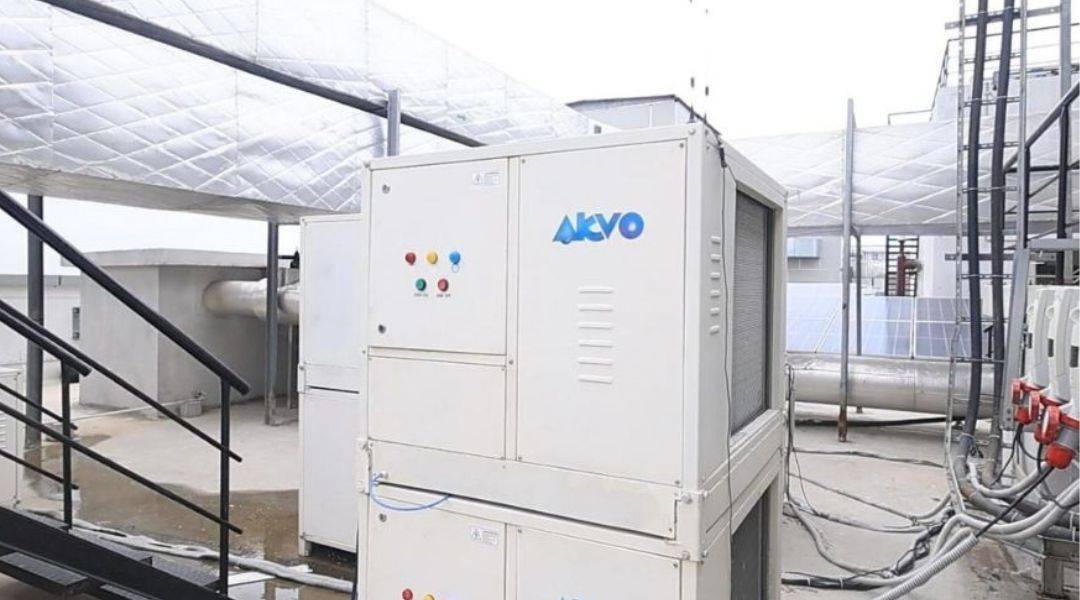
Akvo’s AWG units are compact — requiring just one square metre of space — and operate at just 0.26 kWh per litre under optimal conditions. With pricing as low as ₹1.25 per litre, the systems are already serving sectors like IT parks, hotels, and manufacturing hubs.

“By producing water locally, we eliminate transportation emissions, avoid municipal tariffs, and help businesses meet ESG targets without increasing costs,” added Navkaran Singh Bagga.

Akvo has now expanded into 15 countries, including Qatar and Dubai, generating over 100 million litres of clean water globally. The company is now focusing on fully solar-powered AWGs and mobile container units to serve remote locations and disaster zones.

Bridging Innovation and Accessibility

Despite the advanced technology, Akvo’s mission is rooted in making sustainability accessible. “WoW isn’t just an ESG move — it’s a practical hedge against water volatility. Sustainability is no longer a choice — it’s a license to operate. If you can save money, reduce plastic waste, and secure your water supply—all without capex — why wouldn’t you?” said Navkaran Singh Bagga.

For Akvo, the goal goes beyond business. It’s about changing how we think about water — not just as a resource, but as a sustainable service.

“We don’t want sustainability to be a buzzword or a checkbox. It should be as simple as turning on a tap — and knowing you’re doing right by the planet,” concluded Navkaran Singh Bagga.

To read the full article, please visit here.

Times Tech

On National Technology Day 2025, Akvo CEO Navkaran Singh Bagga Champions Water Innovation

In a special feature by TimesTech, Navkaran Singh Bagga, CEO and founder of Akvo Atmospheric Water Systems, showcased how the company’s pioneering air-to-water technology is transforming global access to clean water. On the occasion of National Technology Day 2025, Bagga outlined Akvo’s mission to deliver decentralized, climate-resilient water solutions through innovations like modular Water Block units, IoT integration, and AI-powered efficiency.

“Our vision is simple yet ambitious,” Navkaran Singh Bagga said. “We want every community—from remote villages to megacities—to access clean drinking water directly from air, without depending on overburdened natural sources.”

With more than 100 million litres of water generated to date, Akvo’s smart systems are addressing critical water challenges across geographies—from coastal cities to arid interiors—while eliminating reliance on plastic bottles and tanker transport.

Reflecting on his own entrepreneurial journey from steel manufacturing to clean-tech, Bagga shared a message for young innovators:

“Dream big, but stay rooted in local realities. The best innovations come from deep empathy for the communities you serve. Focus on creating scalable, sustainable solutions, and don’t be afraid to challenge conventional thinking. Building technology is only half the journey—delivering impact is where true innovation shines. And remember, resilience matters as much as brilliance.”

Looking ahead, Bagga emphasized the role of AI and IoT in making Akvo’s systems more predictive, autonomous, and accessible to underserved populations — further advancing the company’s mission of sustainable, democratized water access.

To read the full article, please visit here.

Dev Discourse

Harnessing Rain Energy and Atmosphere: The Future of Water Sustainability

As climate change threatens freshwater availability, experts are advancing innovative solutions like rain energy harvesting and atmospheric water generation.

Dr. Visakh Vaikuntanathan of Shiv Nadar University is developing ‘all-weather’ cells that harness energy from raindrops and sunlight, integrating seamlessly with rooftops and drainage systems.

Simultaneously, Navkaran Singh Bagga, CEO of Akvo Atmospheric Water Systems, leads the way in generating clean drinking water from air humidity. With operations in 15 countries, Akvo’s Water-on-Want (WoW) initiative, now live in multiple Indian states, offers sustainable, no-CAPEX water access through a BOOT model.

As Himalayan glaciers shrink, technology is also vital in monitoring melt patterns to manage future water flow. On World Water Day, these pioneering efforts shine as hope for water resilience in India.

The CSR Universe

Water-on-Want: Akvo Launches Sustainable Water Solution for Corporates

Akvo Atmospheric Water Systems Pvt Ltd has officially launched its Water-on-Want (WoW) initiative, a breakthrough in sustainable water access for businesses in Tamil Nadu, Karnataka, Maharashtra, and Gujarat.

The program operates under an OPEX-based Build Own Operate Transfer (BOOT) model, allowing companies to access Akvo’s cutting-edge Atmospheric Water Generators (AWGs) without upfront capital investment (CAPEX). Businesses pay only for the water they use, with Akvo handling equipment ownership, installation, maintenance, and operation.

After an 18-month pilot, WoW is now a fully optimized solution offering minimum daily off-take starting at 500 LPD. The model removes financial and operational barriers while promoting eco-conscious corporate water practices.

“WoW is not just technology—it’s a business model that allows companies of all sizes to adopt sustainable water practices without financial strain,” said Navkaran Singh Bagga, CEO & Founder of Akvo.

By eliminating CAPEX and introducing a pay-as-you-go structure, WoW merges sustainability with cost-efficiency—benefiting both companies and the planet.